

1. Project Overview
This solution is designed for the construction of a 60MWh lithium iron phosphate energy storage system consisting of 12 standard 5MWh liquid-cooled battery containers. The system is connected to the grid at 35kV voltage level, mainly applied for grid-side peak shaving, renewable energy supporting facilities, or large industrial and commercial users. Adopting the DC-side parallel connection scheme, the DC sides of the 12 battery containers are collected and connected to the DC side of PCS (Power Conversion System), which reduces AC circulating current and improves system efficiency.
2. Core Product Parameters
The energy storage container system adopts 314Ah battery cells, with battery PACKs configured in a 2P52S series-parallel connection. Each battery cluster includes 8 PACKs and is matched with 1 high-voltage box. The DC circuits of 6 battery clusters are integrated to the isolating switch of the collection and control cabinet to form 1 DC high-voltage circuit. Each energy storage container is equipped with 1 DC high-voltage circuit, as well as auxiliary equipment such as liquid cooling unit, dehumidifier, BMS (Battery Management System) and fire protection system.
2.1 Main Component Configuration of Energy Storage Container
Table 1 Main Component Configuration
No. | Component | Quantity | Remarks |
1 | Battery Cluster / 2P416S | 6 clusters | Electric energy storage device |
2 | BMS System | 1 set | For battery management and monitoring |
3 | High-voltage Box | 6 sets | Primary circuit on-off protection, data detection and processing |
4 | Busbar Distribution System | 1 set | For primary current collection and power supply distribution |
5 | Liquid Cooling Unit | 1 unit | For regulating the temperature of battery PACKs |
6 | Fire Protection System | 1 set | Aerosol fire extinguishing device + gas detector + smoke/temperature sensor + water fire protection |
7 | Dehumidifying Air Conditioner | 2 units | For regulating temperature and humidity inside the container |
8 | Converter (PCS) | 6 units | 5MW, 2 units in parallel for 5MW output |
9 | High-voltage Transformer | 6 units | Step-up from 0.315kV to 35kV |
2.2 Key Technical Parameters of Energy Storage Container
Table 2 Key Technical Parameters
No. | Category | Item | Specification | Remarks |
1 | Electrical Performance | Nominal Capacity | 5015kWh | / |
2 | - | Rated Voltage | 1331.2V | 3.2V per cell |
3 | - | Voltage Range | 1040V ~ 1497.6V | 2.5V ~ 3.6V per cell |
4 | - | Rated Current | 1884A | / |
5 | - | Standard Working Condition | 0.5P | 2500kW |
6 | - | Cycle Life | ≥8000 times | @70% SOH EOL, 95% DOD, 25℃ |
7 | - | DC-side Efficiency | ≥94% | 25℃ |
8 | - | Auxiliary Power Voltage Range | 380VAC±10%, 50/60Hz | Three-phase five-wire system |
9 | Communication | Communication Interface | Ethernet, RS485, CAN | / |
10 | Battery Parameters | Cell Capacity | 314Ah | / |
11 | - | Configuration | 12P416S | / |
12 | - | Number of Battery PACKs | 48 | / |
13 |
| Wiring Mode | Quick Plug | / |
14 | Basic Parameters | Dimension (H*W*D) | 6058x2438x2896mm | / |
15 | - | Color | RAL 9003 | Optional |
16 | - | Weight | ≈42T | / |
17 | - | Anti-corrosion Grade | C4/C5 | / |
18 | - | Protection Grade | IP55 | / |
3. PCS and Step-up System Parameters (Configured by DC-side Scheme)
Table 3 PCS and Step-up System Parameters
Item | Parameter |
PCS Configuration | 6 units of 5MW centralized energy storage converters |
DC-side Input | 1100-1500V DC (connected to the DC bus after current collection) |
AC-side Output | 315V / 690V (adjusted according to PCS outlet voltage) |
Transformer | 6 units of 5MVA oil-immersed transformers (step-up to 35kV) |
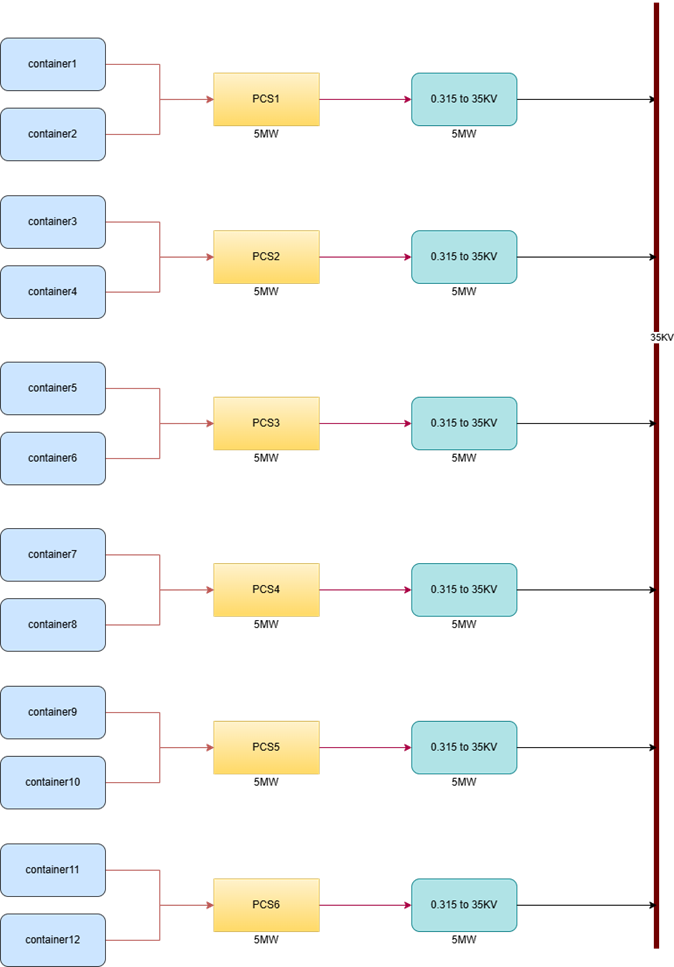
Topology Structure | Each 2 battery containers (10MWh) connected to 1 unit of 5MW PCS |
4. Station Topology
4.1 Description of Main Electrical Wiring Topology
Battery Array: 12 units of 5MWh containers, divided into 6 groups (2 units per group).
DC Current Collection: The 2 battery containers in each group are connected in parallel through the DC circuit breaker cabinet and connected to the DC bus (DC 1500V).
Inversion Unit: The DC bus is connected to 1 unit of 5MW PCS.
Step-up and Grid Connection: The AC output of PCS is connected to a 5MVA transformer (0.315/35kV), and connected to the 35kV bus through the high-voltage switch cabinet after step-up.
4.2 Station Topology Diagram
(Attachment: Topology Diagram of 60MWh DC-Side Energy Storage Station)
5. Construction and Installation Scheme
5.1 Civil Foundation Phase (Approx. 30 days)
Site Leveling: Compaction treatment for the estimated 100m x 80m site, with the requirement of ground bearing capacity > 10t/m².
Foundation Pouring:
• Battery container foundation: Adopt strip foundation or independent bearing platform with pre-embedded cable trench sleeves. The foundation surface height must be higher than the local 50-year flood level or water accumulation level.
• Cable trench: Set up longitudinal and transverse cable tunnels for laying DC cables (attention to separation of strong and weak current).
Grounding Grid: Lay hot-dip galvanized flat steel to form an annular grounding grid with grounding resistance < 0.5Ω.
5.2 Equipment Installation Phase (Approx. 20 days)
Container Hoisting:
• Use a 150-ton mobile crane for unloading and positioning.
• Installation sequence: Hoist the remote containers first, then the near ones to avoid path obstruction.
• After the container is positioned, calibrate the level with a laser level, then fix it (welding or clamping of anchor bolts).
High-voltage Equipment Installation:
PCS and transformers are generally integrated in the step-up cabin (or independent platform) for busbar connection and insulation testing.
Cable Laying:
• DC cable: Adopt special DC cable with a voltage resistance of DC 1.8kV (e.g., YJV-1.8/3kV), with attention to the color distinction of positive and negative poles (red/black) and lightning protection grounding.
• Communication cable: Lay Category 6 shielded network cables or optical fibers along the special bridge of the cable trench, with a distance of > 300mm from the power cable.
5.3 Commissioning Phase (Approx. 15 days)
Single Unit Commissioning: Test the BMS communication, battery cell voltage and internal resistance, and fan start/stop of each battery container one by one.
System Commissioning: PCS no-load operation -> PCS on-load operation -> EMS (Energy Management System) logic test (charging and discharging response time < 40ms).
Grid Connection Test: Conduct anti-islanding protection test and power qua
6. Detailed Technical Parameters
6.1 Battery System
• Cell Specification: 3.2V / 314Ah (1C charge/discharge, energy density > 165Wh/kg)
• Assembly Mode: 2P52S (one battery PACK, voltage 166.4V) -> 8 battery PACKs in series (container voltage 1331.2V)
• Energy Efficiency: ≥ 94% (including auxiliary power consumption, 0.5C charge/discharge)
• SOC Accuracy: ≤ 3%
• Auxiliary Power Supply: AC 380V, 50Hz, power consumption of each container is about 8kW (during cooling)
6.2 PCS System
• Topology Structure: Three-level IGBT topology
• Efficiency: ≥ 98.5% (including transformer)
• Response Time: ≤ 30ms
• Cooling Mode: Air cooling / Liquid cooling (customized according to manufacturer)
• Protection Functions: DC overvoltage, AC overcurrent, insulation detection, anti-islanding protection
6.3 Monitoring and Communication
• Communication Protocol: IEC 61850 (power station level), Modbus TCP/IP (internal system)
• Main Equipment: BMS (Battery Management System), PMS (Power Management System), EMS (Energy Management System)
• Data Collection: Single cell voltage and temperature; single battery cluster current; grid connection point frequency and harmonics.
7. Maintenance and Servicing Scheme
7.1 Daily Inspection
Table 4 Daily Inspection Items
Frequency | Item | Content |
Daily | Appearance Inspection | Check if the container is deformed, the cabinet door is locked, and the sound and light alarm is normal. |
Daily | BMS Monitoring | Check the background for sudden changes in single cell voltage/temperature and SOC jump. |
Weekly | Temperature Control System | Check the normal operation of air conditioners/liquid cooling units, blockage of radiators, and coolant pressure. |
Weekly | Cleaning | Clean the container filter screen to prevent heat dissipation failure caused by dust accumulation. |
7.2 Regular Special Maintenance
Table 5 Regular Special Maintenance Items
Cycle | Item | Detailed Operation |
3 Months | Terminal Tightening | Carry out infrared temperature measurement on the connections of DC-side circuit breakers, fuses and copper bars, and spot-check whether the torque is loose. |
6 Months | Insulation Test | Test the insulation resistance of DC bus to ground with an insulation megger (requirement > 1MΩ). |
6 Months | Fire Protection System Test | Test the sensitivity of smoke/temperature detectors, check the pressure of fire extinguishers, and conduct simulated discharge test if necessary. |
1 Year | Battery Balancing | If the single cell voltage difference > 150mV, perform manual or automatic (BMS) passive/active balancing maintenance. |
1 Year | PCS Dust Removal | Clean the dust in the power modules and heat dissipation air ducts inside the PCS with a high-pressure air gun. |
3-5 Years | Battery Cell Consistency | Conduct a full capacity charge-discharge test, and replace the backward modules with SOH lower than 80%. |
7.3 Emergency Response Plan
7.3.1 Thermal Runaway Alarm
1. Immediately disconnect the DC circuit breaker of the faulty cluster.
2. Start the exhaust system (if designed for smoke exhaust).
3. Confirm personnel evacuation and remotely start the perfluorohexanone/heptafluoropropane fire extinguishing device.
4. If the fire spreads, dial 119 and start the water spray system (ensure the electrical system is powered off to prevent electric shock).
7.3.2 Grid Fault
In case of grid flashover or frequency mutation, the PCS shall automatically switch to standby or grid-forming mode to support the grid. After the fault, check whether the PCS IGBT modules are damaged.
8. Project Economic Indicators (Estimated)
Table 6 Project Economic Indicators
Item | Indicator |
Total System Capacity | 60 MWh |
Rated Power | 30 MW (designed for 0.5C charge/discharge) |
Floor Area | Approx. 5000 - 6000 square meters |
Unit Investment Cost | Approx. 0.8 - 0.95 CNY/Wh (DC-side) |
Estimated Total EPC Investment | Approx. 50 - 57 million CNY |
Annual Operation and Maintenance Cost | Approx. 0.02 CNY/Wh/year |