1. Product Basic Information
• Product Name: Space Perovskite PV Module/Solar Wing
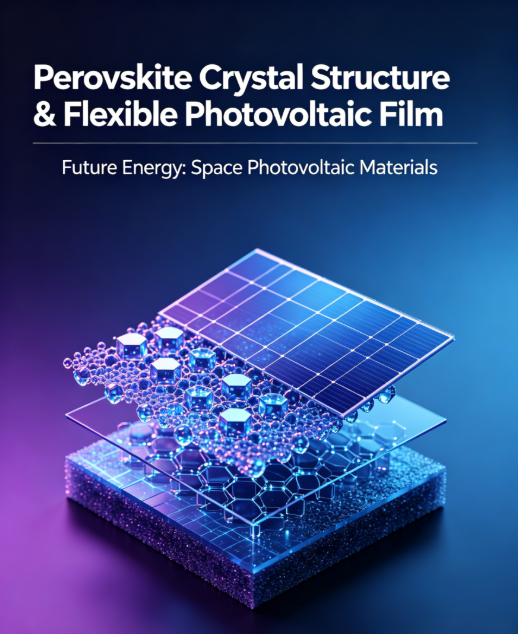
• Core Material: ABX₃-type perovskite crystal (commonly MA/FA PbI₃-based, expandable to all-inorganic and tin-based systems)
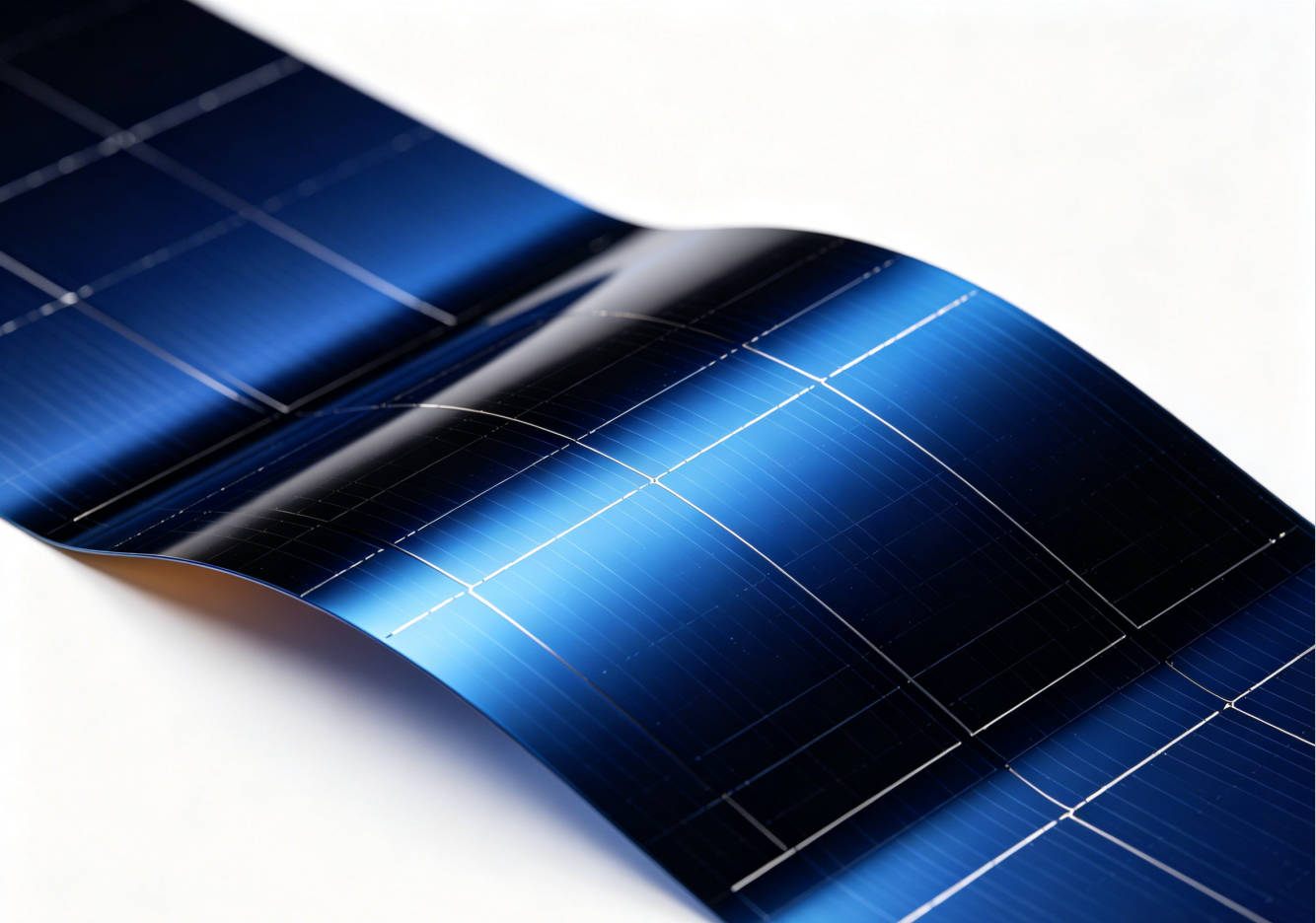
• Product Form: Flexible ultra-thin module (substrate thickness 10-50μm), rigid chip module, all-perovskite/perovskite-silicon tandem module
• Application Scenarios: Low Earth Orbit (LEO) satellite constellations, deep space probes, lunar/Mars bases, space computing centers, deployable space arrays
• Core Positioning: An ultra-lightweight, high-efficiency, radiation-resistant, and low-cost space energy solution, suitable for large-scale deployment of commercial aerospace
2. Core Technical Parameters
Category | Key Indicators | Performance Highlights |
Power Generation Performance | Single-junction Conversion Efficiency (AM0) | ≥25.5% (laboratory); Tandem Efficiency ≥45% (theoretical) |
Power Generation Performance | Specific Power | 20-50 W/g (flexible); more than 80 times that of gallium arsenide |
Power Generation Performance | Low-light Response | Efficient power generation in shadow areas/low-light environments, filling the power supply gap |
Environmental Adaptability | Temperature Tolerance Range | Stable operation from -180℃ to 150℃ |
Environmental Adaptability | Radiation Resistance | Efficiency attenuation ≤10% under 10¹² protons/cm²; With radiation self-healing characteristics |
Environmental Adaptability | Atomic Oxygen/Vacuum Protection | Graphene/metal composite packaging, passing ASTM outgassing test (volatiles <0.1%) |
Mechanical Performance | Flexible Bending Radius | ±120μm repeated bending, suitable for satellite curved surface deployment |
Mechanical Performance | Areal Density | ≤200 g/m² (much lower than gallium arsenide/silicon) |
Cost-effectiveness | Cost per Unit Power | About 1.63 RMB/W, 1/5-1/20 of gallium arsenide |
Cost-effectiveness | Single Satellite Launch Cost Optimization | Weight reduction of 50%+, single satellite launch cost reduced by millions of US dollars |
3. Core Advantages
3.1 Ultra-lightweight, Reducing Launch Costs
The specific power reaches 20-50 W/g, which is 10-60 times that of gallium arsenide and 13 times that of silicon; Under the same power, the weight of the module is reduced by more than 90% compared with the traditional scheme, significantly reducing the satellite load and launch cost.
3.2 High-efficiency Power Generation, Adapting to Space Energy Needs
The tandem efficiency is close to 50% (theoretical), and the single-junction efficiency exceeds 25%, meeting the high-power energy supply in space; It has excellent low-light response and can continuously supply power in satellite shadow areas and deep space low-light environments.
3.3 Super Strong Environmental Adaptability, Ensuring On-orbit Life
The space vacuum and oxygen-free environment avoids the pain point of ground attenuation; The radiation resistance is far superior to that of traditional batteries, with an efficiency attenuation of only 10% under 10¹² protons/cm², and there is a radiation self-healing effect; Wide temperature range tolerance + flexible adaptation, can be deployed on the satellite curved surfaces and deployable structures.
3.4 Low-cost Mass Production, Adapting to Commercial Aerospace
The raw material cost is only 1/100 of gallium arsenide; Solution spin-coating and inkjet printing processes support GW-level mass production with a yield rate of over 92%; No glass/frame is needed, and the manufacturing and deployment costs are significantly lower than traditional space photovoltaic schemes.
4. Technical Specifications and Design Points
4.1 Material and Structural Design
• Substrate Selection: Flexible modules adopt 5-10μm polyimide (PI) substrate with uniform thickness, suitable for flexible bending requirements; Rigid modules are compatible with quartz substrate (light transmission loss reduced to 5%).
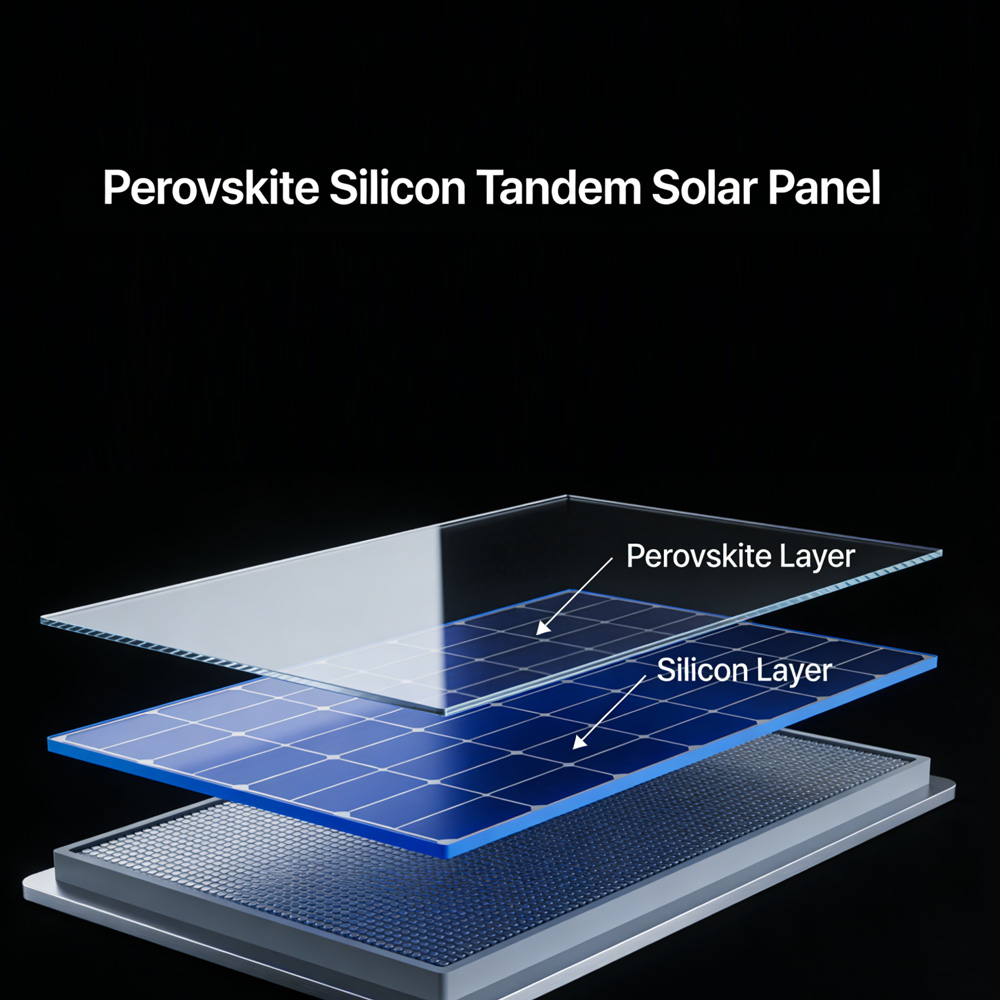
• Tandem Scheme: All-perovskite tandem/perovskite-silicon tandem to improve conversion efficiency and radiation resistance stability.
• Packaging Technology: Atomic Layer Deposition (ALD) Al₂O₃/SiO₂ nano-coating + flexible polymeric film, achieving triple protection of vacuum barrier, radiation resistance and atomic oxygen resistance.
4.2 Space Environment Adaptation Design
• Thermomechanical Stability: Gradient buffer layer (nickel oxide, etc.) relieves the mismatch of thermal expansion coefficient, and the efficiency retention rate is ≥95% after 800 extreme thermal cycles.
• Radiation Resistance Optimization: All-inorganic/2D-3D heterostructure eliminates the risk of organic component decomposition, and improves radiation tolerance with defect passivation technology.
• Vacuum Protection: The ultra-thin packaging system achieves water vapor transmission rate (WVTR) <10 g/m²·day, meeting the requirements of space vacuum outgassing and component stability.
5. Application Scenarios and Adaptation Schemes
Application Scenarios | Recommended Product Form | Core Value |
Low Earth Orbit (LEO) Satellite Constellations | Flexible/Rigid Tandem Modules | Lightweight and cost-effective, suitable for large-scale batch deployment |
Deep Space Exploration (Lunar/Mars) | All-inorganic Rigid Modules | Radiation resistance + wide temperature range, ensuring power supply in extreme environments |
Space Computing Centers | Flexible Ultra-thin Modules | High specific power, suitable for space distributed energy layout |
Deployable Space Arrays | Flexible Wound Modules | High folding and storage ratio, suitable for large-scale space structures |
6. Testing and Certification
6.1 Core Testing Items
• Environmental Simulation Test: Extreme thermal cycle (-180℃~150℃), proton/electron irradiation (10¹²~10¹⁶ cm⁻²), atomic oxygen corrosion, vacuum outgassing test.
• Mechanical Performance Test: Vibration and impact (rocket launch conditions), repeated bending fatigue, curved surface adaptability verification.
• Performance Attenuation Test: On-orbit equivalent 1-3 year power attenuation monitoring, requiring an annual attenuation rate <2%.
6.2 Compliance Standards
Complies with international aerospace standards such as ESA ECSS-E-ST-20-08C, AIAA, and JAXA, and passes full-dimensional ground simulation verification to meet the high-reliability requirements of commercial aerospace.
7. Installation and Deployment Specifications
7.1 Installation Requirements
• Fixing Method: Flexible modules are suitable for satellite curved surface pasting/mechanical buckles; Rigid modules adopt standard satellite solar wing interfaces, compatible with existing deployment architectures.
• Wiring Design: Lightweight flexible bus bars reduce wiring weight; Redundant circuits are reserved to improve system reliability.
7.2 Deployment Process
1. Launch Phase: Folded/wound for storage, adapting to the rocket fairing space;
2. Orbit Entry and Deployment: Deployed by mechanical drive, flexible modules automatically flatten, and rigid modules unlock and deploy;
3. Initial Commissioning: Complete light alignment, power output calibration, and environmental data collection.
8. Safety and Protection
8.1 Safety Precautions
• Production/assembly must comply with electronic material operation specifications to avoid contact with lead/halogen components;
• Vacuum outgassing and electrostatic dissipation tests must be completed before space deployment to avoid contamination of sensitive components of the spacecraft.
8.2 Life and Maintenance
• Theoretical On-orbit Life: 10-15 years (all-inorganic system);
• Ground Maintenance: No regular maintenance is required; On-orbit performance attenuation is monitored through telemetry data, and redundant component switching is triggered in case of abnormalities.
9. Packaging, Storage and Transportation
• Packaging: Anti-static and moisture-proof vacuum packaging with built-in buffer materials to avoid bending/collision during transportation;
• Storage and Transportation Conditions: Store at room temperature and dry place, avoid direct strong light and humid environment; Flexible modules are stored in a wound state, no heavy pressure is allowed.
10. Notes
1. For long-term on-orbit operation, power attenuation must be monitored regularly, and a replacement plan should be triggered when the attenuation rate exceeds 30%;
2. In extreme radiation environments, aerospace-grade radiation-resistant glass/protective film can be matched to further improve stability;
3. Module selection must match the spacecraft load, orbit environment and power requirements, and provide customized schemes to adapt to different mission scenarios.